



Agentic PIM is product information management where AI agents don't just generate content. They run the operational loop themselves.
Find a gap in the catalog. Propose a fix. Apply it once a human signs off.
That's different from what most PIM vendors currently call "AI-powered." Today, that phrase usually means one thing: a button that writes product descriptions for you.
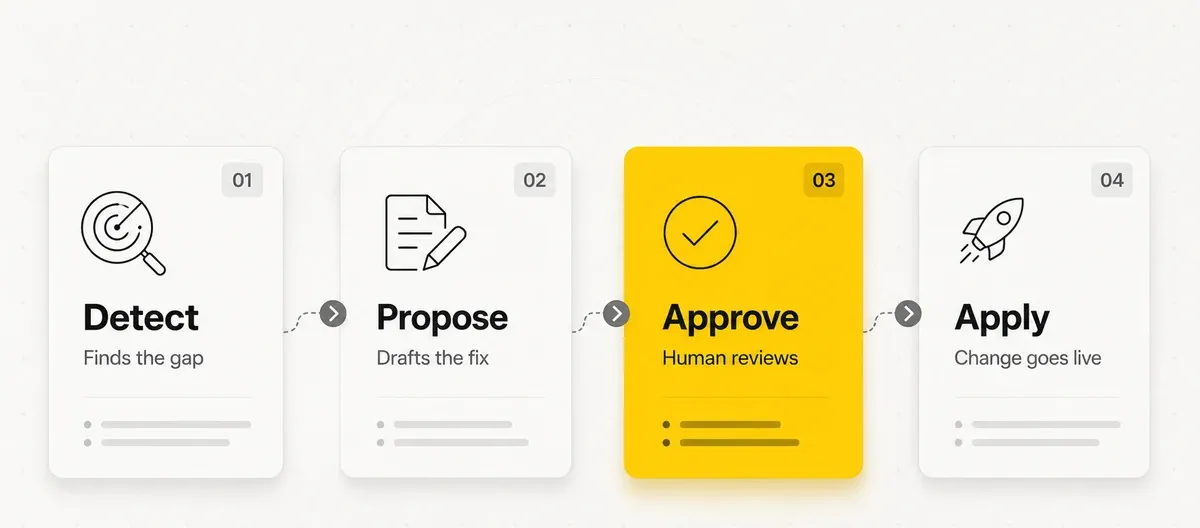
The distinction matters more than it sounds. A description generator saves you typing. An agent that notices your entire denim category is missing a size chart, drafts the fix, and only pings you for approval saves you a job function. Those aren't the same order of change.
In this article, you’ll learn:
The two things people mean by "AI in PIM"
Content generation. You give the system a product. It writes copy, alt text, maybe a translation. You review it, publish it. The AI never touches your data model, your workflows, or your governance rules. It's a faster typewriter.
Agentic operation. The system watches your catalog on its own schedule, not yours. It finds the problem before you do: an empty attribute, a category that drifted out of your taxonomy, a translation gone stale after a price change. It drafts the fix. Then it waits for approval, or in some setups, applies low-risk fixes automatically and logs them afterward.
The second one is what "agentic" is supposed to mean. The term comes from the broader AI industry, describing systems that pursue a goal across multiple steps without being re-prompted at each one.
Applied to a catalog, the goal looks like this: keep this data complete, accurate, and channel-ready, continuously, not just at migration.
AI PIM vs. Agentic PIM: What's Actually Different
| AI PIM | Agentic PIM | |
|---|---|---|
| What it does | Generates or edits content on request: descriptions, alt text, translations | Detects a data problem on its own schedule, drafts a fix, and routes it for action |
| Trigger | A human opens the tool and asks for output | A rule or schedule the system checks continuously, with no human prompt needed |
| Data access | Reads what you give it; doesn't touch the underlying data model | Reads and, in governed setups, writes to the platform through a permissioned interface |
| Human role | Reviews and publishes each piece of content | Approves or rejects a queued change; the checking itself happens without them |
| Failure mode if ungoverned | Publishes mediocre copy you have to rewrite | Silently changes a price or compliance attribute with no audit trail |
| What it actually replaces | Manual writing time | A scheduled manual audit task |
Most PIM platforms sit somewhere between the two right now. A few have shipped real agent infrastructure: systems that let an AI query and write to the platform through a defined, permissioned interface. Others have a chat window bolted onto last year's content-generation feature, with "agent" added to the name.
You won't learn which is which from a press release. Ask one question instead: when the system finds a problem, does it just describe it to a human, or does it queue a change for approval? That question separates most real implementations from the rebranded ones.
A concrete example
A mid-size home goods brand imports 400 new SKUs from a supplier feed every Monday.
Historically, someone on the data team spent Tuesday morning finding the gaps. Missing GTINs. Categories that didn't map cleanly. Descriptions copied verbatim from the supplier's own site, which creates a duplicate-content problem the moment it's indexed.
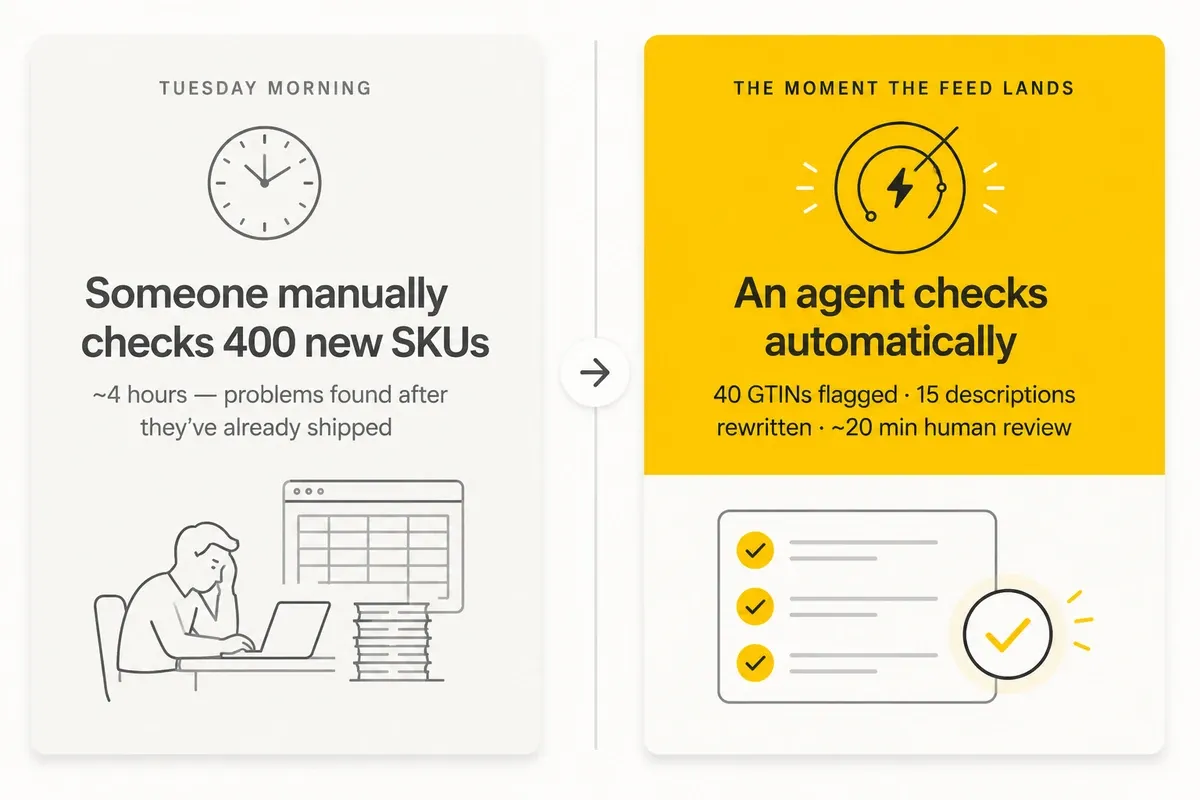
In an agentic setup, that audit doesn't wait for Tuesday. The moment the feed lands:
- An agent checks the new records against the brand's completeness rules
- It flags the roughly 40 records with missing GTINs
- It rewrites the 15 descriptions flagged as duplicate risk
- Everything lands in an approval queue with the reasoning attached: "flagged as duplicate: 94% text overlap with supplier's own product page"
A human spends twenty minutes approving or rejecting. Not four hours finding the problems in the first place.
That's the actual shift. Not "AI writes better copy." The audit stops being a scheduled human task and becomes a standing condition of the system.
Why analysts are pricing this as more than a feature update
Gartner's research on product data for agentic commerce puts a number on it: by 2030, roughly one in five digital commerce transactions will run through an AI platform's own checkout or an AI agent, not a human clicking through a storefront.
Newest Gartner's Hype Cycle for Digital Commerce this year went further, naming "Agentic Buying" as its own category: AI agents evaluating and completing purchases with little human involvement, treated as infrastructure to build for now, not a distant scenario.
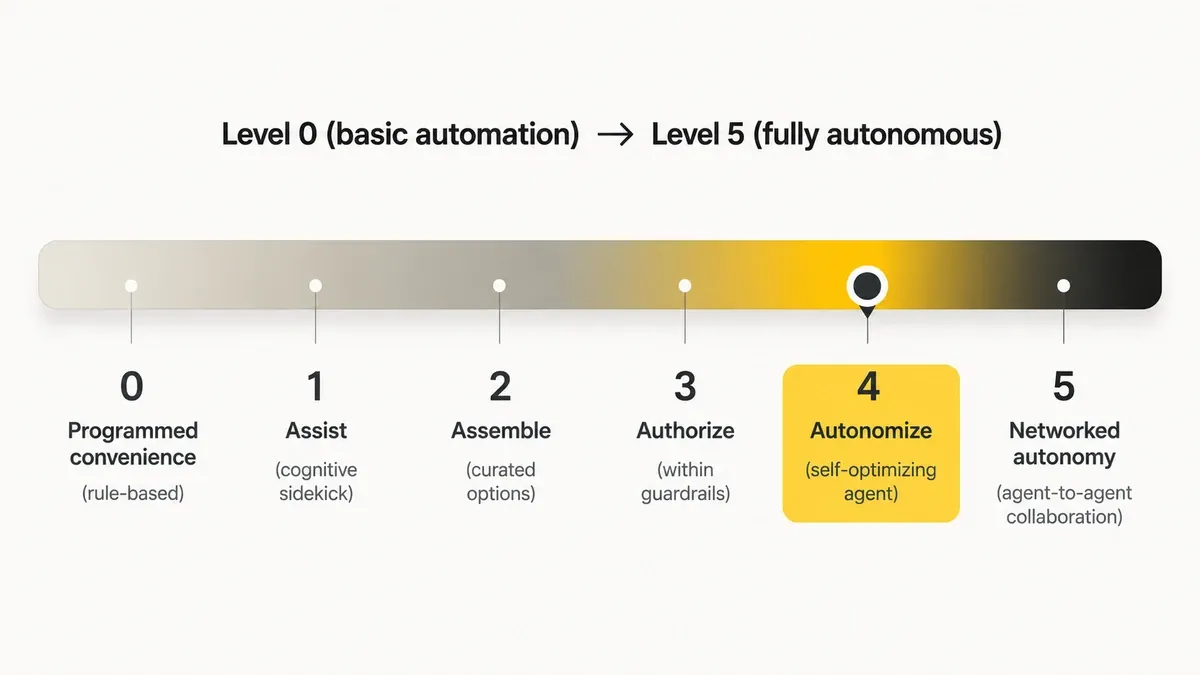
McKinsey puts the ceiling higher over a longer horizon. Their October 2025 research estimates AI agents could mediate $3-5 trillion of global consumer commerce by 2030 under a moderate-adoption scenario. They've also proposed a six-level "automation curve" for how much of the shopping journey gets delegated to an agent, from Level 0 (basic subscribe-and-reorder automation) up to Level 5, where the agent runs against a standing goal ("make sure we never run out of baby supplies," to use McKinsey's own example) instead of approving each purchase one at a time.
Neither firm has used the phrase "Agentic PIM" yet. They describe agentic commerce broadly, not the specific category of software that has to supply the data underneath it.
That's worth sitting with. The data foundation is the less glamorous half of a very glamorous-sounding trend, and it's the half almost nobody is asking hard questions about yet. An agent operating at McKinsey's Level 4 is only as good as the product data it reads. Missing GTINs or inconsistent size attributes don't cause a visible failure. The agent just quietly stops recommending the product, and the brand finds out from a revenue dip three months later, not from an error message.
What this looks like if you're not an enterprise brand
Most writing on agentic PIM so far describes deployments built for teams with dedicated data engineers and six-figure software budgets. If you're running a five-person team with 2,000 SKUs, that's not your Monday.
The scaled-down version looks like this: instead of a human periodically checking the catalog for gaps, a lightweight process runs on a schedule, nightly or weekly, checking a defined set of rules.
Every product has a category. Every image has alt text. Every variant has a price. Whatever's broken gets surfaced with a fix already drafted, not just a red flag.
The "agent" part isn't a chatbot you talk to. It's the fact that the checking and the fixing happen without you remembering to schedule them.
That's a smaller, less dramatic claim than "AI runs your catalog." It's also the version a small team can actually build now, rather than something to wait for a $50k enterprise contract to unlock.
The part vendors don't put in the press release
Handing an agent write access to your catalog is a governance decision, not just a technical one.
The systems worth taking seriously include an approval step for anything that isn't trivially reversible. The ones that don't should make you nervous, not impressed. An agent that can silently change a price or a compliance-relevant attribute, an allergen list, a safety rating, without a human in the loop isn't more advanced. It's a liability with good marketing.
The honest framing: agentic PIM is useful in proportion to how well it's governed, not how autonomous it sounds in a demo. A system that flags 40 problems and drafts 40 fixes for a five-minute human review is doing real work. A system that quietly makes 40 changes overnight with no audit trail is doing something else.
FAQ
Is Agentic PIM the same as AI-generated product content? No. AI-generated content is one output an agentic system might produce, but "agentic" describes the operating loop: detecting a problem, proposing a fix, acting on approval. Not just the ability to write text.
Do I need an enterprise PIM to use agentic features? No, but most of what's currently marketed as agentic PIM is built for large catalogs and dedicated data teams. Smaller teams can get a scaled-down version: scheduled, rule-based checks with a drafted fix attached, running automatically instead of manually.
What's the risk of giving an AI agent write access to product data? Ungoverned changes. An agent silently altering a price, a compliance attribute, or a safety-relevant field without human review. Systems worth using log every change, explain the reasoning, and gate anything non-trivial behind approval.
Will "Agentic PIM" become a standard term? It's new enough (the phrase only started appearing in vendor material in mid-2026) that analysts like Gartner and McKinsey haven't adopted it. They describe the broader trend as "agentic commerce." Whether the PIM-specific term sticks likely depends on whether it ends up describing a real technical capability or just this year's marketing label.