


In this article, you’ll learn:
Shopify is great at running your storefront. But once your catalog crosses a few hundred SKUs — or you start selling across multiple channels — its native tools start to strain. Variant caps, no data governance, no version history, no structured way to push consistent content to Amazon, retail partners, and your own store at once.
That's what a PIM solves. We reviewed 8 PIM systems that work with Shopify. For each one, we looked at how the Shopify integration actually works, who it's built for, and where it falls short.
Quick Comparison
| Tool | Best for | What stands out | What to watch |
|---|---|---|---|
| Toriut | Shopify-first teams that want product data and assets closer together | Built around Shopify workflows, practical for catalog work | Less proven than larger enterprise platforms |
| Akeneo | Mid-market and enterprise teams that want structure without going fully custom | Strong PIM reputation, multi-language and catalog structure | Shopify fit depends on connector setup and workflow |
| Plytix | Smaller teams moving out of spreadsheets | Easier onboarding, collaborative editing | May feel limited as catalog complexity grows |
| Pimcore | Complex catalogs with technical resources in-house | Highly flexible, broad platform scope | Heavier setup, more technical ownership |
| Salsify | Brands selling across multiple channels | Strong syndication and broader commerce use case | Can be more platform than a Shopify-only team needs |
| Bluestone PIM | Growing brands with richer content and more collaborative workflows | Cloud-native, API-first, strong with rich product content | Better fit when budget and complexity are already growing |
| Sales Layer | Teams that want faster time to value | Easier rollout, good fit for multi-channel basics | May not be deep enough for the most complex structures |
| Perfion | Large businesses with complex product models and ERP-heavy environments | Strong depth for structured product data | Not the lightest option for smaller Shopify teams |
Choosing a PIM for Shopify: 8 Systems to Compare
1. Toriut
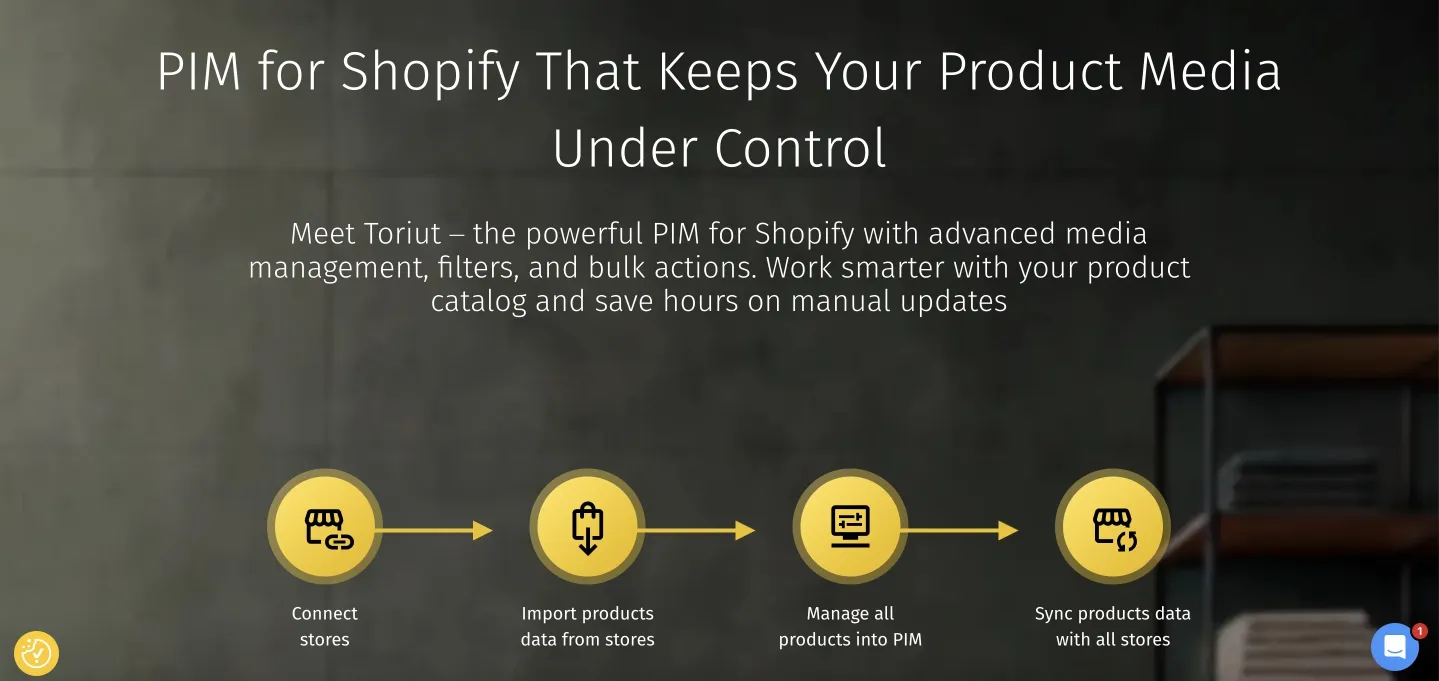
Toriut makes the most sense for teams that already live in Shopify and want a cleaner way to manage product data without layering on a system that feels far removed from how the business actually works.
Its appeal is fairly practical. It brings product data, catalog work, and digital assets closer together, which matters when the real problem is not abstract “data governance,” but the everyday friction of updating products, matching images to variants, finding the right version, and keeping catalog work from turning into a manual mess.
That is also where Shopify-first positioning matters. Some PIM platforms are broad by design. They can do a lot, but they often feel built for a wider enterprise environment first and for Shopify teams second. Toriut goes in the other direction.
It is especially relevant for smaller and mid-sized eCommerce businesses growing out of spreadsheets, disconnected media folders, or patchwork product workflows.
The trade-off is pretty clear too. If your business already has a very complex enterprise data model, deep retailer syndication requirements, or a long list of custom integration needs, Toriut should still be compared against heavier platforms before you decide.
2. Akeneo

Akeneo is one of the better-known names in PIM, and there is a reason it keeps showing up on shortlists. It is easier to trust than newer tools because the market already understands what it is for.
For Shopify teams, Akeneo becomes relevant when the catalog is no longer simple, but the business is not necessarily looking for a fully custom platform either. It is a reasonable middle ground for companies that want more structure, stronger product data organization, and better support for working across regions, languages, or broader catalogs.
Another reason teams look at Akeneo early is that it feels like a “real PIM” without immediately forcing the conversation into a deeply technical project. That matters for eCommerce teams that know they have outgrown spreadsheets and native storefront tools, but do not want implementation to turn into a product of its own.
That said, the important question is not whether Akeneo is capable enough. It usually is. The question is whether the Shopify workflow feels right once the connector, publishing logic, and daily product operations are taken into account. A platform can look strong on paper and still create friction in practice.
3. Plytix

Plytix makes more sense for smaller teams than for highly complex catalog environments.
That is not a criticism. In many cases, it is exactly the point. A lot of Shopify businesses do not need a heavyweight platform. They need something that gets them out of spreadsheets, makes collaboration easier, and gives product information more structure without forcing a long implementation cycle.
That is where Plytix tends to be appealing. It is usually easier to picture inside a lean eCommerce team. The interface is approachable, the learning curve is less intimidating than with heavier systems, and the value is easier to explain internally when the business is still at the stage of fixing inconsistent product data, slow updates, and scattered ownership.
For a smaller Shopify store or a growing brand with a relatively straightforward catalog, that can be enough.
The caution here is simple: teams with fast-growing complexity should be realistic. A tool that feels refreshingly simple early on can start feeling narrow once workflows, attributes, and publishing requirements become much more demanding.
4. Pimcore

Pimcore is the kind of platform that starts making sense when a business has already accepted that product data is not going to stay simple.
It is not just a PIM. It sits in a broader platform category and gives companies more flexibility than most tools on this list. That is a strength, especially for businesses with complicated product structures, multiple data relationships, high-volume catalogs, and technical teams that can support a more customized setup.
For the right company, that flexibility is a real advantage. Pimcore can be shaped around the business rather than forcing the business into a lighter, more pre-defined model.
For the wrong company, that same flexibility becomes overhead.
This is why Pimcore is usually better framed as a fit for enterprises or technically mature teams. A smaller Shopify brand that mainly needs to clean up product information and reduce manual work may find it too heavy. A larger company with more demanding requirements may find that heaviness justified.
5. Salsify
Salsify starts making more sense once Shopify is only one part of the picture.
If you are selling across several channels and need stronger control over consistency, syndication, and product content performance, Salsify deserves a serious look. Its relevance grows when the business is no longer managing one neat storefront, but a wider commercial environment where product information has to move across retailers, marketplaces, internal teams, and other distribution points.
That is an important distinction. Some PIMs are mostly about internal product-data structure. Salsify sits closer to a broader commerce and product experience conversation. That can be valuable for brands that already feel the pressure of multi-channel operations.
It can also be more system than a Shopify-first team actually needs.
So the question here is less about quality and more about fit. If Shopify is just one channel in a much wider content and commerce setup, Salsify looks stronger. If your pain is still mainly internal catalog management inside a Shopify-centered workflow, it may be worth comparing against leaner options first.
6. Bluestone PIM
Bluestone PIM is easier to justify when the business is already growing into a more modern, collaborative product-content environment.
It leans into cloud-native and API-first positioning, which makes it appealing for brands that want flexibility and expect their catalog operations to keep expanding. It is also easier to see the value when product data is closely tied to richer content, multiple contributors, and faster-moving workflows.
That makes it interesting for growing brands with more than basic catalog needs, especially when collaboration around product content has already become a real operational issue.
It is probably not the first tool to look at if the business is still small and mainly trying to escape spreadsheet chaos. It makes more sense when there is already enough complexity to justify a more ambitious setup.
7. Sales Layer

Sales Layer is worth shortlisting for one reason many teams underestimate: speed matters.
A lot of businesses do not need the deepest or most customizable PIM. They need something that gets implemented, gets adopted, and starts reducing manual work without dragging the team into a long project. Sales Layer is often positioned well for that kind of buyer.
It tends to appeal to companies that want better synchronization across channels, more organized product data, and a faster path to day-to-day value. That can make it a good match for mid-sized teams that know they need more structure, but are wary of overly heavy platforms.
The limitation is predictable. If your product hierarchy is especially deep or your requirements are highly specialized, a quicker system may stop short of what you need later. That does not make it the wrong choice. It just means it is better suited to some growth stages than others.
8. Perfion

Perfion is better understood as a platform for more structured, more demanding product environments.
It becomes more relevant when the catalog is large, product relationships are complicated, ERP dependencies are strong, and the business needs more depth than lighter Shopify-friendly tools usually offer. That is why it tends to resonate more with larger companies than with lean eCommerce teams looking for a fast operational fix.
For businesses with complex product models, that depth is the point. The more structured and technical the environment becomes, the easier it is to see why a tool like Perfion belongs on the shortlist.
For smaller Shopify teams, it may simply be too much platform for the problem at hand.
How to Choose Without Overbuying
A lot of teams choose the wrong PIM for a simple reason: they buy for the most impressive future version of the business, not for the product-data reality they are actually living with now.
A better way to choose is to focus on four questions.
How messy is your catalog today?
Not in theory. In practice.
How many SKUs are you managing? How many variants? How many people touch product data? How often do updates happen? How many places currently hold “the latest” version of the information? A PIM should remove friction from that reality, not introduce a new layer of it.
Is Shopify your center of gravity?
Some businesses sell through many channels and already need broader syndication logic. Others still run most product operations through Shopify and mostly need better structure around that core workflow.
That difference matters more than teams sometimes expect. A strong PIM for a broader commerce stack is not automatically the best PIM for a Shopify-centered team.
Do you need depth or speed?
Some tools are stronger because they go deeper. Others are stronger because they are easier to adopt.
That is a real trade-off. If you choose a highly flexible platform without the resources to support it, the project gets heavier than it should. If you choose a lightweight platform while your catalog complexity is already accelerating, you may outgrow it sooner than planned.
How much implementation weight can your team realistically handle?
This is the part teams often skip in demos.
A good product-data system should make the work clearer and faster. If the rollout, governance model, or day-to-day upkeep feels like a major operational burden from the start, that cost is part of the decision too.
Final Take
There is no single best PIM for Shopify.
There is a better question, though: which platform matches the way your catalog actually works right now?
Some teams need a lighter system that helps them clean up product data, move faster, and stop relying on spreadsheets. Others need deeper structure, stronger multi-channel control, or a platform that can support a more complex enterprise environment.
The wrong choice is usually not the weaker tool. It is the tool that adds more system than your team is ready to use.
FAQ
At what point does Shopify stop being enough on its own?
Usually not when you hit a specific SKU count, but when product updates start taking too much coordination. If new launches depend on spreadsheets, last-minute fixes, and several people checking the same data in different places, the problem is no longer just catalog size. It is workflow strain.
What usually breaks first when a Shopify catalog gets harder to manage?
In most teams, it is not the storefront. It is the process behind it. Variant logic gets messy, product details drift between channels, images stop matching the right products, and nobody is fully sure which version is current. That is often the point where a PIM starts making more sense than another spreadsheet.
Will a PIM actually speed up product launches?
It can, but only if launch delays are really caused by product-data chaos. A PIM will not fix weak planning or unclear ownership on its own. What it does fix well is scattered information, repetitive manual updates, and poor visibility into whether a product is actually ready to go live.
Is it better to choose a PIM with DAM capabilities, or keep media separate?
That depends on where the mess is. If your biggest problem is structured product data, a standalone PIM may be enough. If product images, videos, and variant-specific assets are already creating extra work, keeping data and media closer together can save a lot of friction.
What kind of Shopify team tends to outgrow spreadsheets first?
Usually a team with a growing catalog, many variants, and more than one person touching product content. Once eCommerce, marketing, merchandising, or operations all start editing the same product information, spreadsheets stop being a flexible tool and start becoming a source of risk.
Enjoyed this article? Try Toriut's free beta — or book a demo, and we’ll gladly walk you through everything and answer all your questions.


